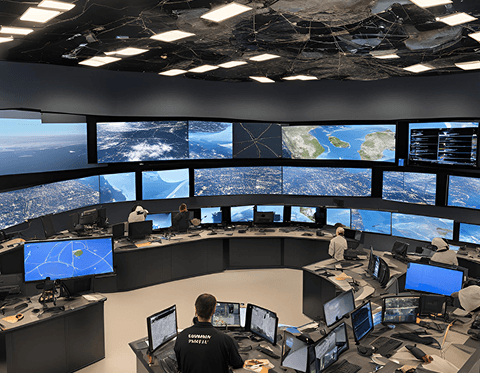
An Immersive Virtual 3D Gallery exploring how AI is reshaping disaster response
An Immersive Virtual 3D Gallery exploring how AI is reshaping disaster response
An Immersive Virtual 3D Gallery exploring how AI is reshaping disaster response
Investigating how AI and emerging technologies are transforming disaster response and humanitarian relief
Investigating how AI and emerging technologies are transforming disaster response and humanitarian relief
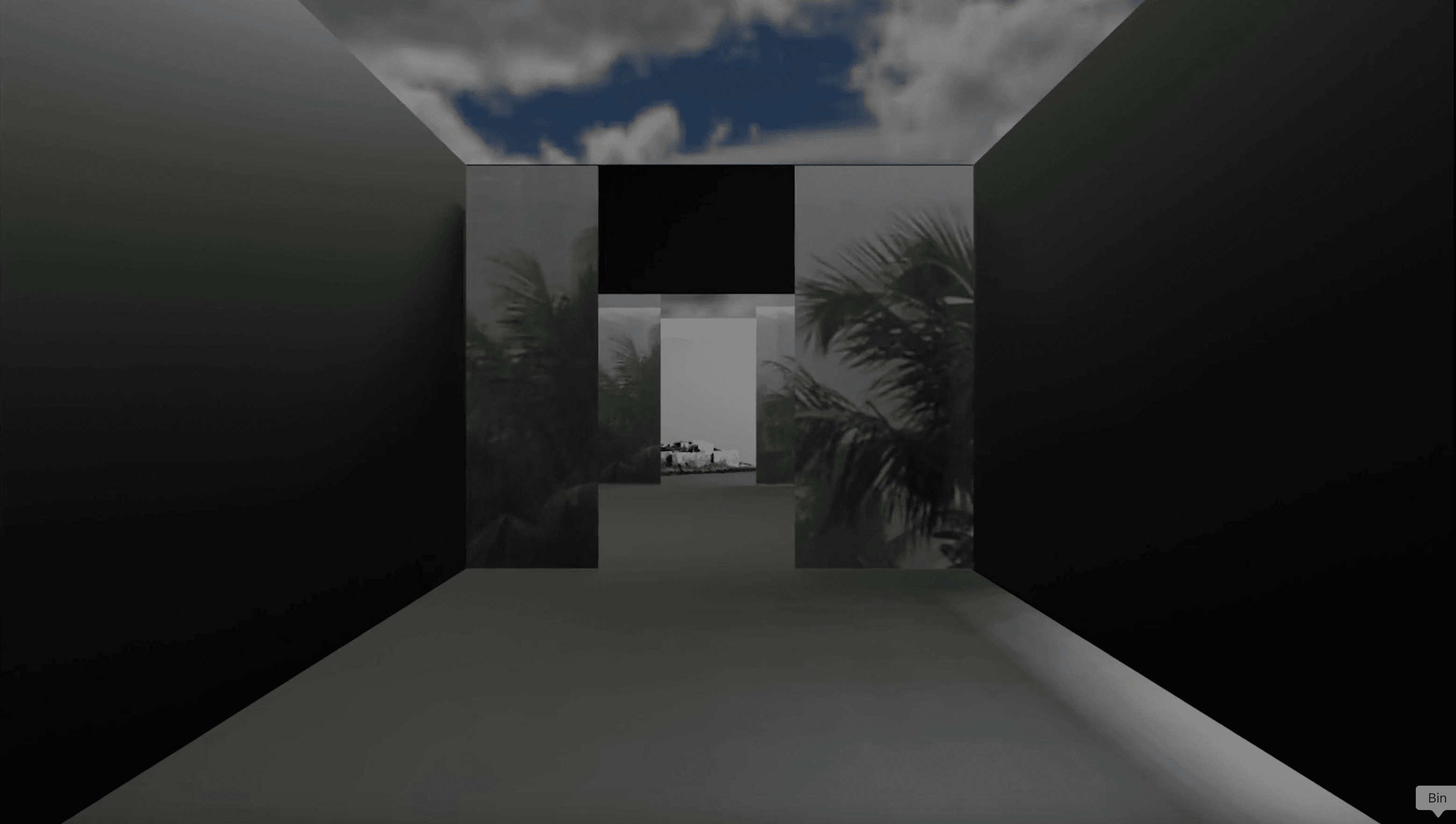
Tools
Blender
Timeline
9 Weeks (Oct - Dec 2024)
Team
Solo
My Role
UX Designer / 3D Experience Designer
Organisation
University Project
"AI cannot prevent disasters — but it can change how we respond to them''
"AI cannot prevent disasters — but it can change how we respond to them''
This insight became foundational for the gallery's narrative, shaping the spatial journey.
This insight became foundational for the gallery's narrative, shaping the spatial journey.
My Design Process
My Design Process
~5-7 min skim or deeper read
PRIMARY RESEARCH: IMMERSIVE GALLERIES
Learning from physical exhibitions to inform virtual spaces
Learning from physical exhibitions to inform virtual spaces
Secondly, I researched how immersive environments communicate ideas. To understand how emotion and narrative are created spatially, I visited several immersive exhibitions. Two had the strongest influence on my design approach:
Secondly, I researched how immersive environments communicate ideas. To understand how emotion and narrative are created spatially, I visited several immersive exhibitions. Two had the strongest influence on my design approach:
Frameless Immersive Exhibition
Each room had a distinct atmosphere and focus, which created a clear progressive narrative. The multi-sensory nature of the experience deeply informed my spatial transitions.
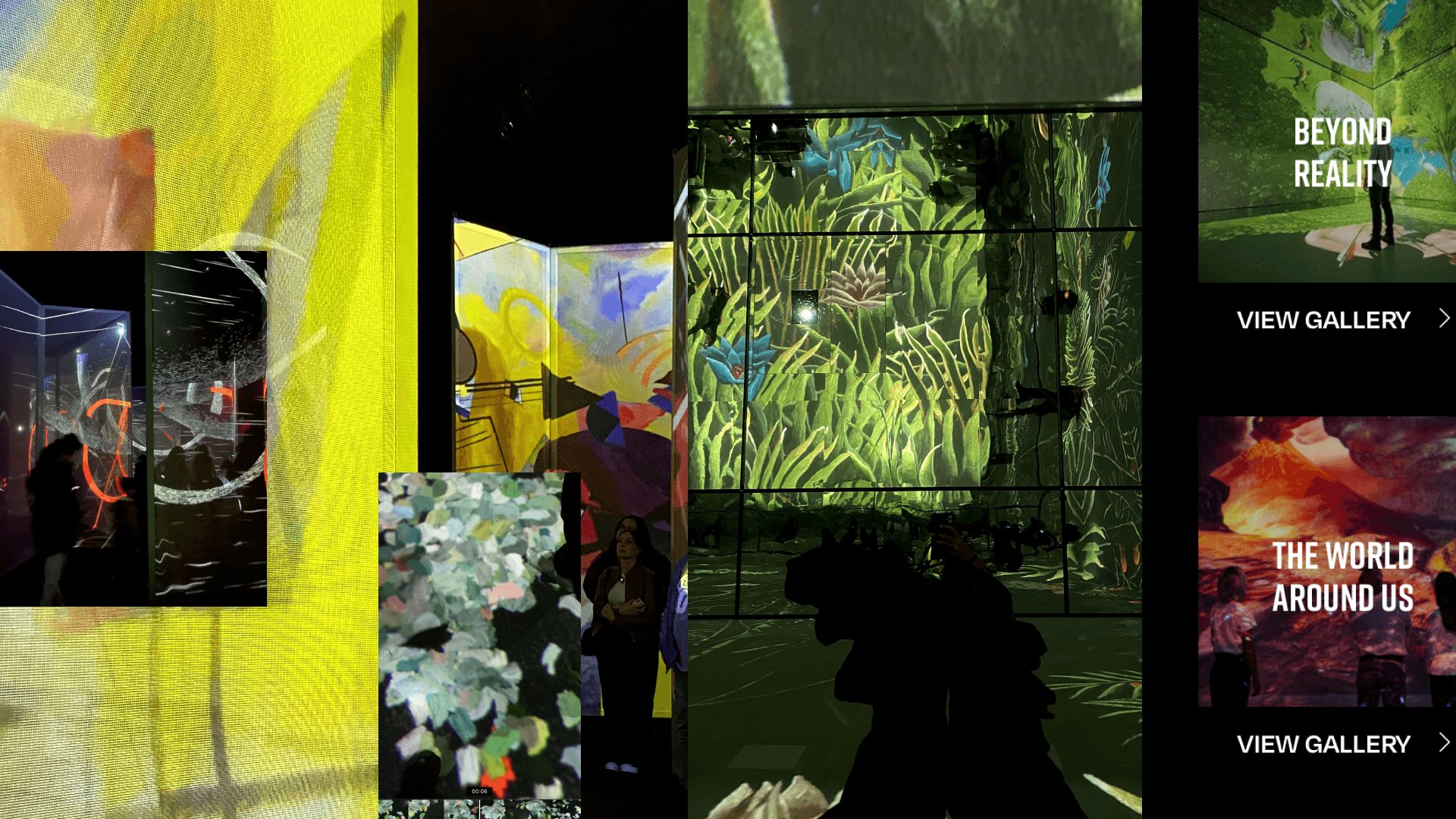
Frameless - Immersive Art Experience - 4 Galleries
“Scratch & Sniff” by Urs Fischer
I was inspired by how the artwork interacted with the architecture itself — paint on the floor, spatial separation, and irregular layouts made the environment part of the story.
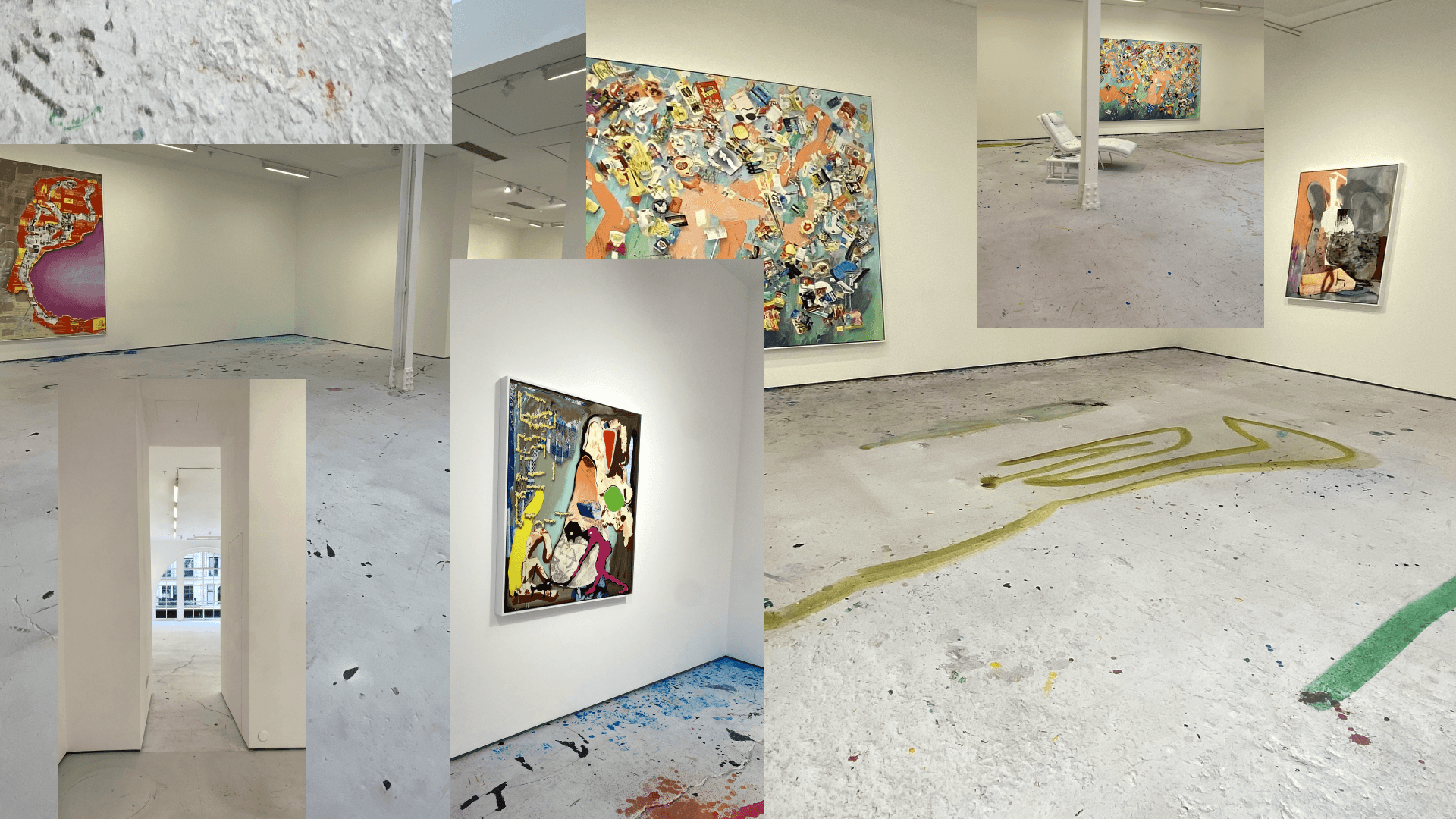
Sadie Coles Gallery - Urs Fisher Art - Scratch & Sniff
Frameless Immersive Exhibition
Each room had a distinct atmosphere and focus, which created a clear progressive narrative. The multi-sensory nature of the experience deeply informed my spatial transitions.
Frameless - Immersive Art Experience - 4 Galleries
“Scratch & Sniff” by Urs Fischer
I was inspired by how the artwork interacted with the architecture itself — paint on the floor, spatial separation, and irregular layouts made the environment part of the story.
Sadie Coles Gallery - Urs Fisher Art - Scratch & Sniff
Frameless Immersive Exhibition
Each room had a distinct atmosphere and focus, which created a clear progressive narrative. The multi-sensory nature of the experience deeply informed my spatial transitions.
Frameless - Immersive Art Experience - 4 Galleries
“Scratch & Sniff” by Urs Fischer
I was inspired by how the artwork interacted with the architecture itself — paint on the floor, spatial separation, and irregular layouts made the environment part of the story.
Sadie Coles Gallery - Urs Fisher Art - Scratch & Sniff
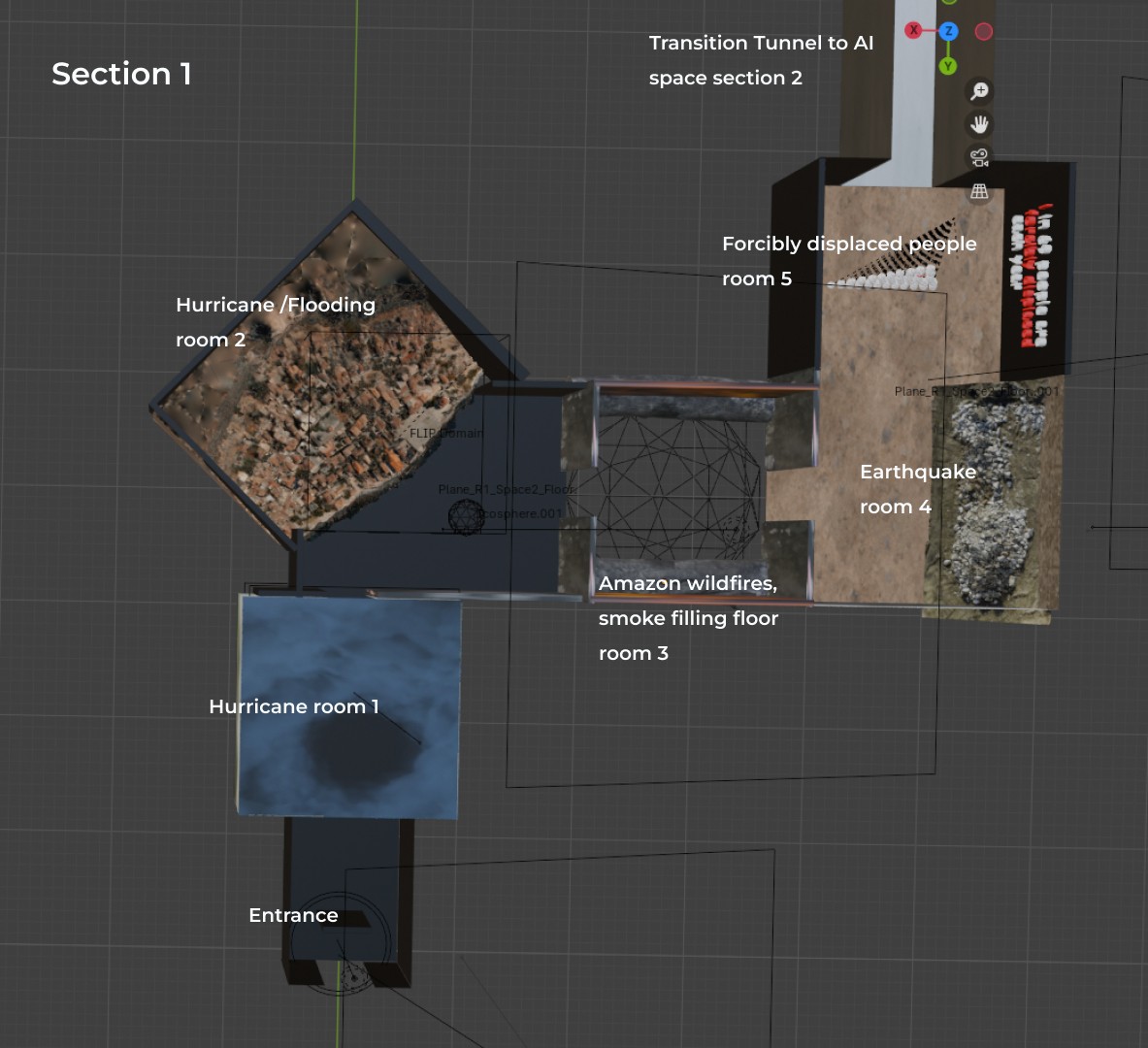
Section 1 - Experiencing disaster
The first section focuses on emotional engagement, using immersive visuals, soundscapes, and spatial storytelling. Visitors are immersed in the human impact of natural disasters.
Rooms included:
Entrance: Atmospheric lighting and sound to set the tone
Hurricane Room: 360° storm projections
Flooding Simulation: Rising water visuals
Wildfire Room: Smoke effects and projections
Earthquake Room: Data-driven visuals showing destruction and displacement
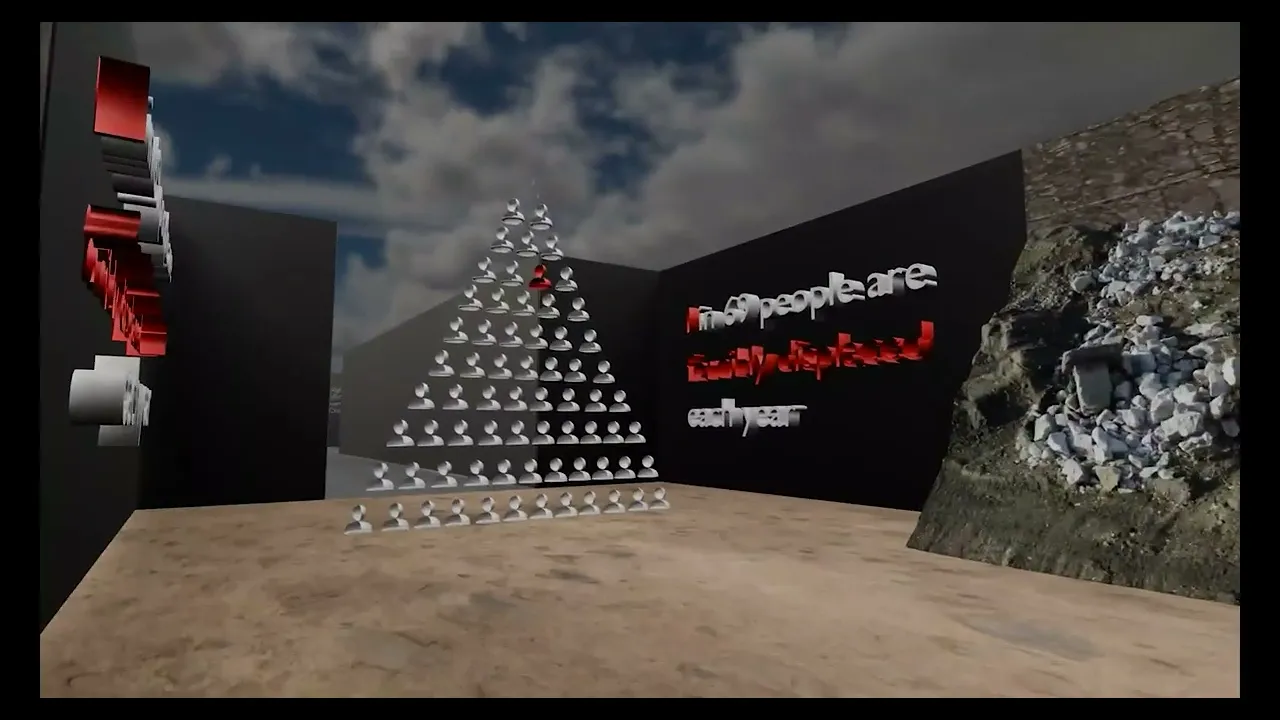
Forced Displacement: A 3D visualisation highlighting that 1 in 69 people are forcibly displaced globally
The first section focuses on emotional engagement, using immersive visuals, soundscapes, and spatial storytelling. Visitors are immersed in the human impact of natural disasters.
Rooms included:
Entrance: Atmospheric lighting and sound to set the tone
Hurricane Room: 360° storm projections
Flooding Simulation: Rising water visuals
Wildfire Room: Smoke effects and projections
Earthquake Room: Data-driven visuals showing destruction and displacement
Forced Displacement: A 3D visualisation highlighting that 1 in 69 people are forcibly displaced globally
Section 2 - AI-powered solutions
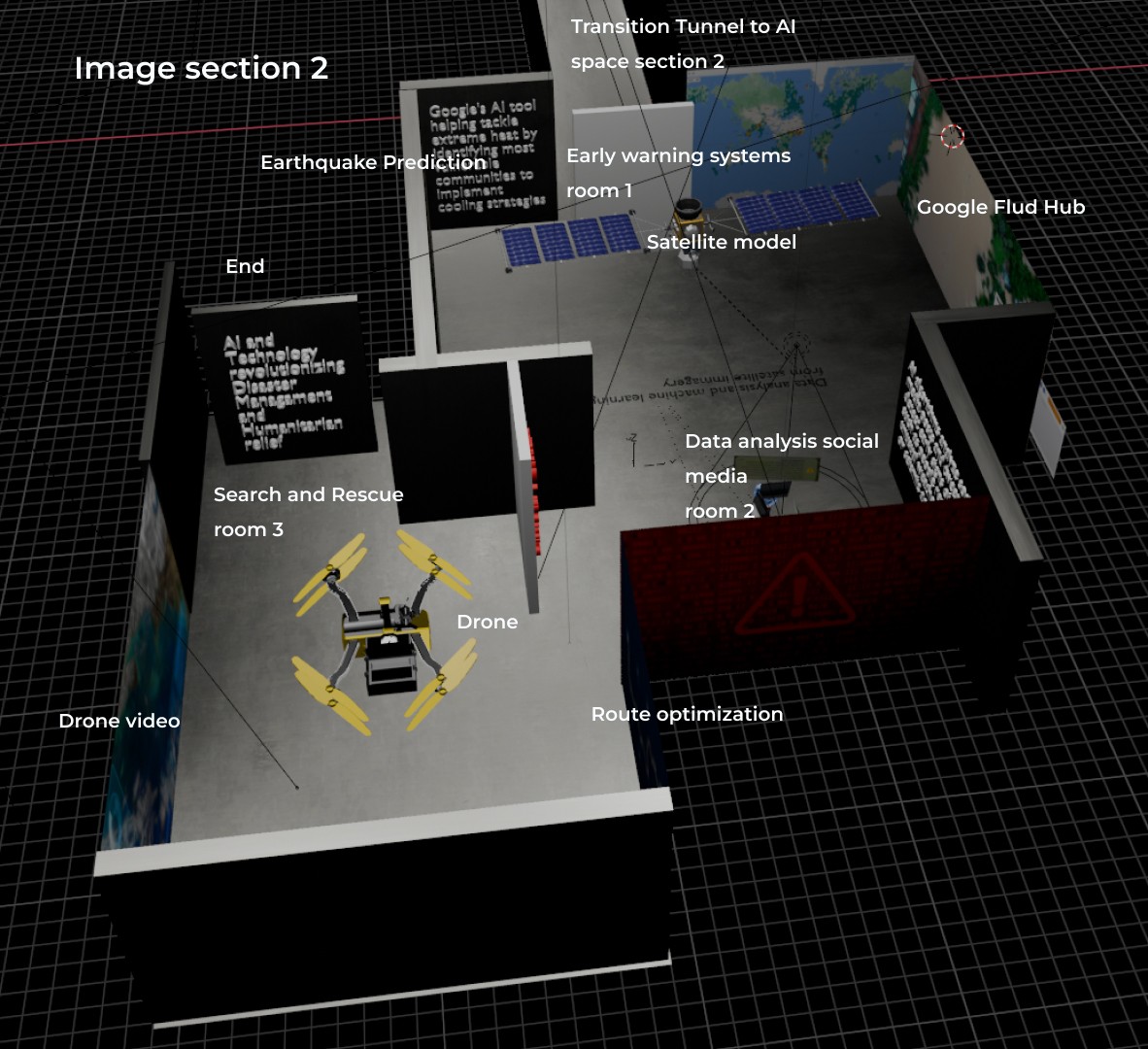
The second section shifts tone, focusing on how AI is already transforming disaster response. The user is taken away from chaos into clarity through technology.
Rooms included:
Key moments included:
Early Warning Systems: A rotating 3D satellite model demonstrating prediction and prevention
Data Analysis: Visualising AI-driven monitoring and social media analysis
Search & Rescue: A moving drone model illustrating AI-optimised rescue routes
The journey ends with a reflective moment, encouraging visitors to reconsider AI’s role in humanitarian contexts.
The second section shifts tone, focusing on how AI is already transforming disaster response. The user is taken away from chaos into clarity through technology.
Rooms included:
Key moments included:
Early Warning Systems: A rotating 3D satellite model demonstrating prediction and prevention
Data Analysis: Visualising AI-driven monitoring and social media analysis
Search & Rescue: A moving drone model illustrating AI-optimised rescue routes
The journey ends with a reflective moment, encouraging visitors to reconsider AI’s role in humanitarian contexts.
DEVELOPMENT
Adapting tools and workflows under tight constraints
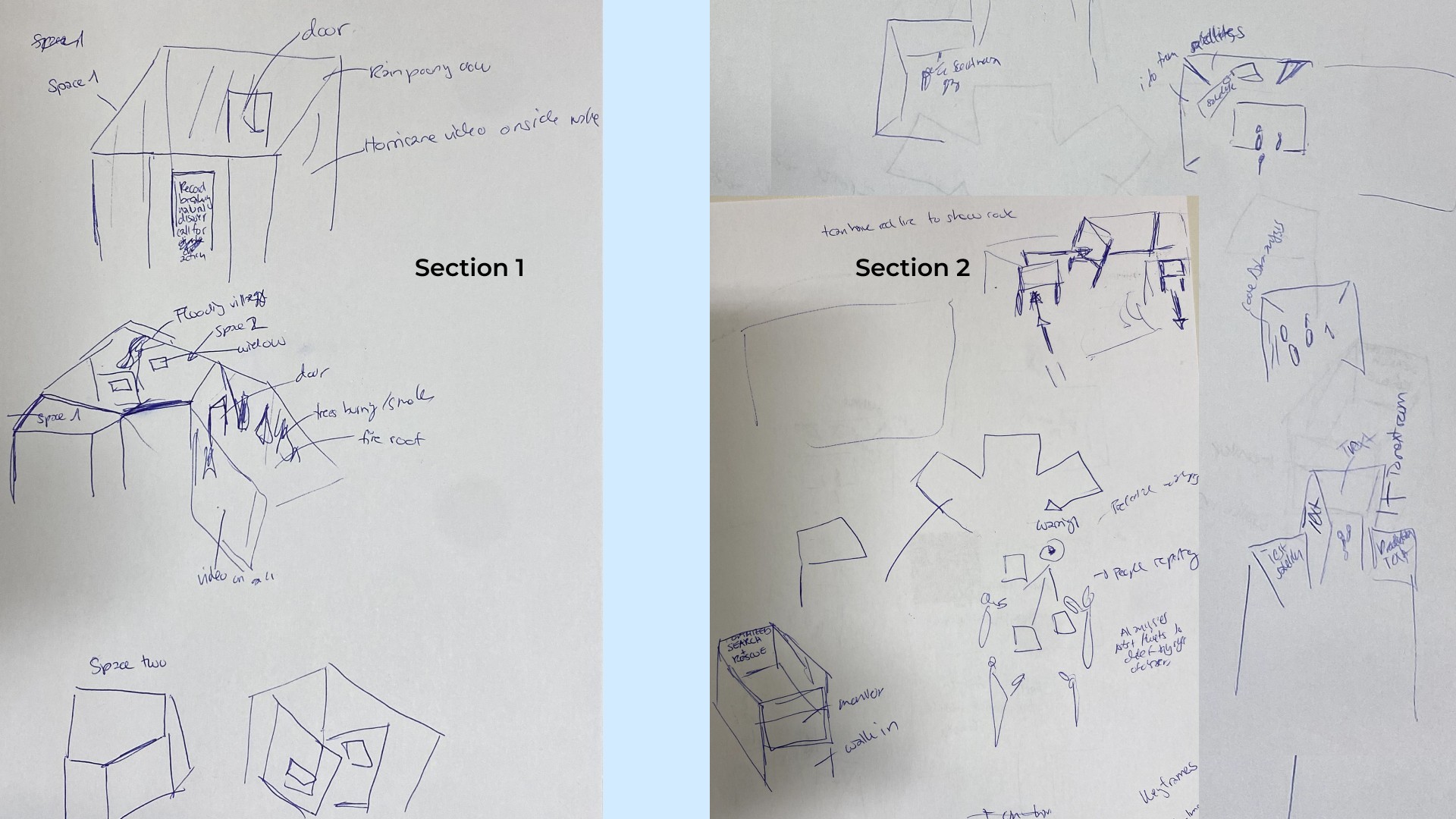
The development process involved sketching spatial layouts, brainstorming visual metaphors, and iterating on 3D environments.
Initially, I began building the experience in Unreal Engine, but due to hardware limitations, I pivoted to Blender, a tool I had never used before. With only three weeks available, I prioritised storytelling and data visualisation over technical perfection.
I organised and categorised all data into 6 groups:
What didn't help users improve their mental wellbeing.
Methods that did work.
Avoidance Patterns
Present stigma: Men aren't allowed to show emotions.
Impacts of stress and pressure.
Communication struggles.
FINAL OUTCOME
The final outcome is a fully realised virtual 3D gallery presented through a video walkthrough. The experience communicates complex systems through space, motion, and narrative rather than text-heavy explanation.
REFLECTION & LEARNINGS
What this project taught me
What this project taught me
This project strengthened my understanding of spatial storytelling and immersive UX design. Key learnings included:
Immersive experiences can be powerful tools for education and awareness
Combining physical metaphors with digital data increases emotional engagement
Technical limitations are part of the design process, not a failure of it
Learning Blender under time pressure reinforced the importance of adaptability and prioritisation.
This project strengthened my understanding of spatial storytelling and immersive UX design. Key learnings included:
Immersive experiences can be powerful tools for education and awareness
Combining physical metaphors with digital data increases emotional engagement
Technical limitations are part of the design process, not a failure of it
Learning Blender under time pressure reinforced the importance of adaptability and prioritisation.
NEXT STEPS
How this project could evolve
How this project could evolve
If continued, I would:
Refine special effects to increase immersion
Conduct user testing to validate emotional and educational impact
Develop a companion website to extend the experience beyond the gallery
Further iterate on 3D models, lighting, and textures for realism
If continued, I would:
Refine special effects to increase immersion
Conduct user testing to validate emotional and educational impact
Develop a companion website to extend the experience beyond the gallery
Further iterate on 3D models, lighting, and textures for realism
Let's connect, to build something great together!
Copyright
© 2025 Elisa Gruosso
All rights reserved
Contact
Become Friendly
Let's connect, to build something great together!
Copyright
© 2025 Elisa Gruosso
All rights reserved
Contact
Become Friendly
Tools
Figma, Miro
Timeline
14 Weeks (2023)
Team
Solo
My Role
End to End UX /UI Process
Organisation
University Project